Unless you’re a hermit isolated in a mountain cabin with WiFi, everyone reading this has and will interact with *shudder* people. For some folks, being social can be a minefield of interactions with friends, family, coworkers, and sometimes your spouse. The cool thing is that you’re not alone in these feelings.

It’d be kind of nice to have some strategies on hand to help navigate through potentially awkward situations or arguments. It’d also be nice to avoid conversational hassles, too. Fortunately, there are a few mind tricks that others have mastered that people were eager to share on Reddit.

These little brain workarounds are helpful mini-guides to have better interactions with other people, bend conversations your way, or fantastic methods to outright avoid awkwardness altogether. Here are 15 of the best upvoted tips people have shared on what to do if you’re stuck in very common social scenarios.

1. Ask your date what they DON’T want.

“One that I picked up from a friend of mine whenever he was trying to pick out dinner with his girlfriend. Rather than asking ‘What do you want?’ and getting the typical ‘I don’t know, anything’ answer and then having suggestions shot down, start with ‘What do you NOT want?’

Used it a few times in some of my relationships and it’s the godsend question.”

2. “Agree” with a person’s anger.

“If they are at a level ten you come in at a level seven. Being completely calm, reserved, and polite only pisses people off more as you ‘clearly don’t understand the magnitude of the situation.’ If they are screaming and yelling, you need to come in loud but not attacking them…agreeing with them (to a point):

– ‘Whoa, the f**k is going on?’

– ‘I understand why you are f**king pissed, I would be pissed, too.’

– ‘Yeah, that is some bullsh*t, the situation really sucks.’

– ‘Look, I get it. I would be angry as sh*t, too, but us screaming is going to get anything done, no matter how angry we are.’

– ‘I’m with you, I’d be just as upset.”

– ‘No doubt, this is annoying but these are our options.’

By agreeing with their anger they are more open to listen to you… Works pretty much every time, but there might be a little up and down in the middle. Just follow the person’s lead while always being a level below them.”

3. Just say “hello.”

“Saying hello to everybody you know, and with a smile. Often people who know each other from when they were in primary school or just from the block when they were young give each other an awkward smile instead of a happy ‘good day!’ If someone walks into you twice a year and both times you smile and greet them enthusiastically, they will think of you as a nice person.”


4. Divert eye contact to divert questions towards someone else.

“If you find yourself in a group situation where someone (a leader, tutor, manager, etc.) is asking questions that must be answered and you want to avoid being picked so that you don’t have to talk, then here is my tip: If the person locks eyes on you as they ask the question, then just as they are about to get to the end of their question, break eye contact and look towards another person in the room and hold it. Their attention is diverted to that other person just as the question ends and the person they are now looking at feels compelled to answer. If, however, the person starts asking the question while looking at someone else then look at that other person and hold it so you can’t get suckered. Use it sparingly because if you do it enough on the same person, they will be on to you.”

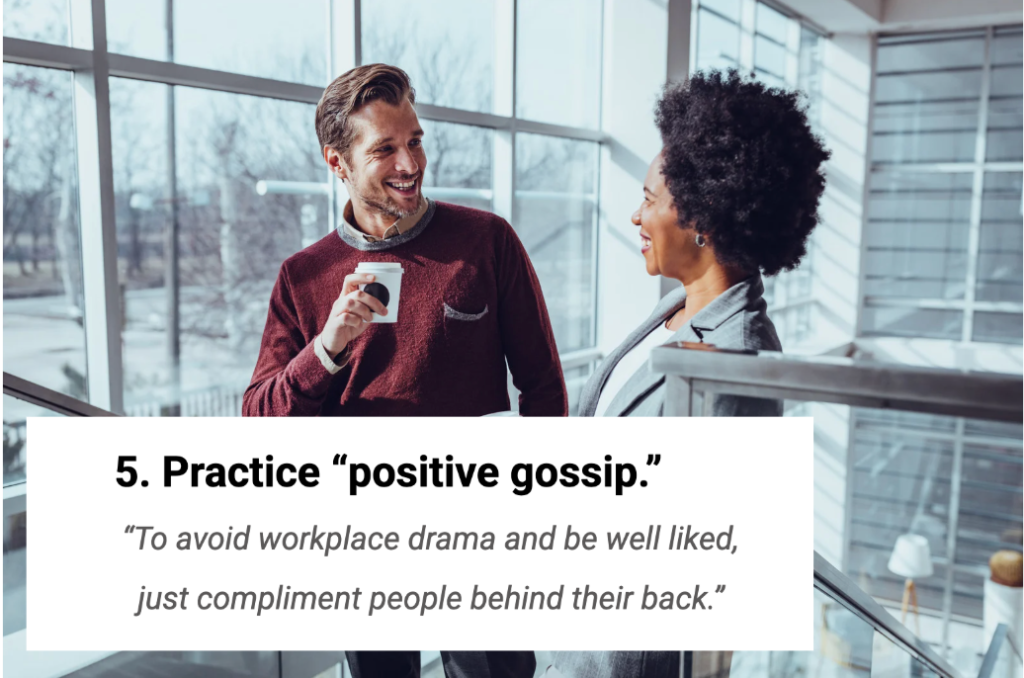
5. Practice “positive gossip.”

“To avoid workplace drama and be well liked, just compliment people behind their back.”

6. If you’re bothering your spouse, shift the conversation to their interests.

“When I do something annoying or bothersome to my husband and he goes quiet, I wait a few minutes and then I ask him a seemingly innocent question, usually on the subject of how certain parts of a car works, or something mechanical. This gets him talking about the car thing and he rambles for like five minutes and then bam! He’s happy again and not quietly brooding. I’ll never tell him I do that because I’m afraid it won’t work anymore if he knows about it. It’s foolproof though, it works every single time, no matter how bothered he is.”

7. You can learn a lot about a person by just shutting up.

“Listening to someone without giving advice or pushing for more information typically nets me more information than being pushy for it.”

8. Laughter makes the best distraction.

“I’m a professional poker player. When I am in a pot with one other player, I often try to make them laugh when they are thinking about what to do. If you can get them to laugh, it sets them in a mood where they are unlikely to bluff. I talk a lot in general, it’s very common to make jokes at the table, even in hands.”

9. Shift your mood before socializing through music.

“Putting headphones on and playing the music that I know I’d want to hear if I was in the mood that I want to be in shifts me over to that mentally, and really helps when I need to calm down or when I need to feel happier.”

10. A winning argument starts with an agreement.

“In an argument, find something to agree on then push your main point.”


11. The perfect convo combination when bumping into acquaintances.

“My wife calls this the simplest, most manipulative thing I do.

Whenever I bump into an acquaintance (meaning not friend, just a person i know) I of course say hi and the conversation goes like this:

Me: ‘Hey! How are you, [person’s name]? You look good!’

Them: ‘Thank you, I’m good, how are you?’

Me: ‘I’m great, I’m on the way to [wherever I am going at the time and I tell them why, too]. So what are you doing here?’

Them: ‘ [Goes into the same details to tell me where they’re going and why]’

Me: ‘Alright, well I won’t keep you up any longer. Have a good day, [person’s name]!’

It leaves people feeling good, takes away the awkwardness of cutting a convo short, and it makes them want to leave.”

12. Turn hiccups into a debate to stop them.

“If someone says they have the hiccups, ask them to prove it. 9/10 times, their hiccups will disappear. Having to summon a hiccup in order to demonstrate will trick your diaphragm into just not hiccuping. I’ve been able to twist it around on myself with some success as well, but it takes practice. You realize you have hiccups, then actively try to make yourself do another one. It’ll stop.”

13. Instead of apologizing, say thank you.

“Thanking someone for a trait you want from them. Instead of telling a customer you’re sorry for their wait, thank them for their patience or understanding. Works wonders.”

14. The final answer to the endless toddler “why?”

“My friend responded to her toddler’s seventh question in an extreme “but why” chain with “well, why not?” in a really happy voice. Her son looked completely mind blown and stopped asking.”

15. Be direct and assign tasks rather than leaving your request open for volunteers.

“Be direct and personal when you need things. Instead of asking if anyone has an EpiPen ask who has an EpiPen. Instead of saying, ‘Someone call 911,’ point to someone and say, ‘You in the blue jacket, what’s your name? Tom? Okay, Tom, go call 911 and come tell me when they are on their way.’”

*Note: Some entries were edited for clarity.

  • Happiness expert’s refreshing take that the best friendships are useless
    Women laughing on scooters.Photo credit: Canva
    ,

    Happiness expert’s refreshing take that the best friendships are useless

    “If you want to be happier you need more useless.”

    As Americans have become more tribal, isolated, and downright lonely, the need for quality friendships is at an all-time high. Yet, some of the most important relationships begin when we aren’t looking for them. Sometimes something seemingly insignificant, like a simple hobby or a mutual love, slowly grows into a real connection.

    Dr. Arthur Brooks shared his insights into friendships on the Mighty Pursuit podcast. He explains that there are three types of friendships, and the one that matters most is a useless friendship.

    Aristotle believed friendship was the secret to happiness

    (Discussion begins at 1 hour into the video.) Brooks traces the value and importance of friendship back to the famous philosopher Aristotle. He explains that Aristotle believed the ultimate secret behind a happy life was friends. Brooks says, “In the Nicomachean Ethics, he [Aristotle] said there’s three levels of friendship that bring more happiness. And if you get stuck at lower levels, it’s going to be a problem for your life.”

    The first type of friendship is transactional. These are people with whom you do business or have a casual acquaintance. You don’t really know them on a personal level. The relationship is friendly, but if business or a reason for interacting stops, so does the friendship.

    Brooks describes transactional friendships, saying, “There’s nothing wrong with it, it’s just incomplete.” He continues, “If that’s all you have you’re going to be hopelessly lonely.”

    The second type is friendships of beauty. They are chosen out of admiration. These are people we want to be around. Brooks describes it as, “You’re magnetic. It could be because of your physical beauty, your sense of humor, your intelligence, or your success.”

    Relationships built on admiration are better than transactional, but Brooks warns, “If that beauty goes away, so does that friendship.”

    sporting events, transactional friends, admiration, everyday connextion
    Fans at a sporting event.
    Photo credit Canva

    Useless friends are the best

    Aristotle described the friendship that brings the most satisfaction as Atelic, meaning it has no specific end or goal. Brooks calls it “Useless. It’s cosmically, beautifully useless. And so if you want to be happier, you need more useless people you just love.”

    Describing the characteristics of this type of friend, Brooks shares, “you’re walking together, shoulder to shoulder, into the future and looking at something you both love mutually.” He continues, “There’s always a third love in these perfect friendships.”

    Examples offered by Brooks might be a couple loving their children or best friends who love a sports franchise. Brooks says, “It can be dumb, or it can be cosmic. But the whole point is that third love is the glue that makes that, that useless relationship beautiful and perfect to you.”

    laughing friends, kinship, well-being, companionship
    Women laughing and dancing.
    Photo credit Canva

    Science loves a useless friendship

    Research supports Aristotle’s belief that having a friendship without an agenda makes for a richer and happier life. A 2023 study in Frontiers found that friendships valued for the stimulating companionship and shared activities predicted higher well-being, life satisfaction, and personal growth. Best friends aren’t based on networking or usefulness.

    A 2024 study in the National Library of Medicine found that high-quality best friendships lowered loneliness and boosted self-esteem. Meaningful relationships can begin with a shared love, but over time, become a part of who the friends actually are.

    hobbies, mutual interests, shared space, proximity relationships
    Friends enjoy drinks together.
    Photo credit Canva

    A 2022 study at Cornell University revealed that repeated physical proximity and similar interests strongly increased the likelihood of friendship formation regardless of background or social differences. Activities like walks, hobbies, sports, and creative interests offered a shared space where even unlikely friendships grow.

    Brooks suggests the most important friends come from connecting over the smallest things. They don’t happen because we need them; more so, they exist for their own sake. These “useless friendships” are grounded in mutual joy and common loves. They may seem small or incidental at first, but the Atelic relationship shapes our happiness the most.

  • Benefits of mindfulness meditation go far beyond relaxation – here’s what it is and how to practice it
    Mindfulness meditation is a process of noticing difficult thoughts and feelings rather than shutting them out.Photo credit: Marco VDM/E+ via Getty Images
    ,

    Benefits of mindfulness meditation go far beyond relaxation – here’s what it is and how to practice it

    Yuval Hadash J. David Creswell magine being asked to sit alone in a quiet room for 15 minutes with nothing to do – no phone, no music, no external distraction. In a well-known 2014 study, many participants found that task so challenging that they chose to press a button to give themselves an unpleasant electric shock instead…

    magine being asked to sit alone in a quiet room for 15 minutes with nothing to do – no phone, no music, no external distraction. In a well-known 2014 study, many participants found that task so challenging that they chose to press a button to give themselves an unpleasant electric shock instead of continuing to sit with their thoughts and sensations.

    Because being with their own thoughts, emotions and bodily sensations can be so difficult, people often turn away from them. Smartphones offer constant distraction from boredom or stress, allowing users to disengage from their present-moment sensations and thoughts with a quick swipe or tap.

    But avoiding unpleasant internal experience can backfire. Studies show that doing so is associated with a range of mental health problems, including anxiety and depression.

    We are psychological scientists who study mindfulness and how it affects stress, health and well-being.

    Mindfulness is a mental state that people can learn to cultivate through training. When people are mindful, they direct their attention toward their moment-to-moment bodily sensations, emotions and thoughts, and they meet those experiences with an attitude of curiosity and open acceptance.

    Mindfulness can be cultivated through “mindful moments” in daily life, moments in which people intentionally stay present with what they do, hear, see or feel. However, formal mindfulness meditation involves sustained practice that systematically trains attention and acceptance. Our research shows that training acceptance during mindfulness meditation can substantially improve your emotional well-being.

    Tuning into experience can be hard – and helpful

    Popular culture often portrays mindfulness as a way of relaxing. But we’ve found that mindfulness practice can often feel surprisingly difficult. In one of our studies, participants who directed their attention to their thoughts and feelings during a 20-minute mindfulness meditation noticed six times more unpleasant experiences than pleasant ones.

    This doesn’t mean they were doing it wrong. Turning your attention inward can feel challenging. Often, it brings you into contact with experiences that you normally try to push away, such as feeling bored, uncomfortable or agitated. However, we’ve also found that facing difficult experiences during mindfulness training can have positive effects.

    In particular, adopting an accepting attitude toward your experiences seems to drive many of the positive effects of mindfulness. Our research shows that developing the capacity for acceptance through mindfulness meditation can reduce feelings of loneliness and increase positive emotions, such as happiness. It also reduces stress hormones and helps people notice more positive experiences during stressful situations.

    In these studies, we have found that acceptance is the critical driver. When acceptance is removed from mindfulness training, these benefits largely disappear.

    The power of learning to accept experience

    A key part of mindfulness practice involves turning toward difficult experiences, such as like stress, boredom and pain, rather than seeking distractions or pushing those experiences away. It means noticing feelings and thoughts as they arise, sensing how they show up in the body, and approaching them with an attitude of acceptance rather than judgment or resistance.

    A helpful way to think about this comes from the “two arrows” metaphor, which is rooted in East Asian Buddhist traditions. It teaches that there are two types of suffering, which can be likened to being struck by two arrows.

    The first arrow is the unavoidable unpleasant experience that comes with being human – for example, feeling exhausted after a poor night’s sleep. The second arrow is how we react to that unpleasantness: tensing up, resisting it, replaying it in our mind, criticizing ourselves or trying to escape it. Often this second arrow adds more suffering than the original unpleasant experience.

    In mindfulness practice, the goal is not to stop having unpleasant sensations and feelings. Instead, mindfulness helps people accept the unavoidable difficulties of that first arrow and to soften the second arrow by letting go of struggle with those experiences and reactions that make them worse.

    For example, let yourself feel bored without immediately reaching for distraction. Acknowledge anxiety, sadness or grief with openness, instead of trying to suppress those feelings or fueling them with harsh self-criticism.

    Practicing mindfulness in everyday life

    One way to cultivate this attitude is to treat thoughts, emotions and sensations as guests in your inner landscape. Instead of fighting them or clinging to them, notice when they arise. Acknowledge and welcome them, and when they naturally change, let them go. Some people find it helpful to imagine holding a difficult feeling as they would a crying baby, with a touch that’s steady, supportive and kind.

    If you want to try this in daily life, the next time you feel a challenging experience, pause and open to the experience for a moment. Notice what you are feeling. Where does it show up in your body – a tightness in the chest or heaviness in the stomach? Can you allow it to be there, even briefly, without trying to fix it or distract yourself from it?

    A driver's hand tightly grips a steering wheel with traffic visible ahead.
    Mindfulness means acknowledging and accepting challenging feelings, such as stress and frustration from unexpected delays. LB Studios/Connect Images via Getty Images

    Then observe what happens. Does the challenging experience change over time in any way? Do your reactions shift or soften with repeated practice? Remember that a brief practice is unlikely to produce instant relief, and expecting quick results can actually make it harder to stay open to your experience as it is.

    Rather, our findings suggest that meaningful change comes through consistent, ongoing practice. Every small step matters. Over time, brief moments of responding to stress or discomfort with mindfulness can reshape how you relate to challenges and provide greater resilience and ease.

    In the study where people chose electric shocks over sitting alone with their thoughts, being with their inner experience felt almost intolerable. Mindfulness offers a different path: not escaping that experience but learning to stay with it. In doing so, what once felt unbearable can become something you can meet with greater emotional balance and well-being.

    This article originally appeared on The Conversation. You can read it here.

  • She was afraid that becoming paralyzed would end her marriage. He refused to leave.
    A man holds his wife's hand.Photo credit: Canva

    “For better or worse, till death do us part” is the traditional ending to wedding vows. After a woman suffered a devastating injury that left her paralyzed from the waist down, those promises were no longer just words.

    In a Reddit post titled “am paralyzed and think my husband should leave me but he doesn’t want to,” a 31-year-old woman shared her challenging situation. Despite being married for five years and raising two children together, her spinal cord injury left her questioning the strength of their marriage.

    family, hope, emotional support, caregiving
    A happy family smiling.
    Photo credit: Canva

    He refuses to leave

    In the thread, she explains that she has a loving, supportive husband. They’ve been together for eight years, and he’s always been amazing. She then explains the current situation:

    “Recently, I suffered a spinal cord injury that has left me paralyzed from the waist down. Doctors say it’s unlikely I’ll walk again. Since this happened, I can’t shake the feeling that my husband should leave me. I know it sounds awful, but I’ve seen so many stories online about partners leaving after someone becomes seriously ill or disabled. It’s made me incredibly insecure.”

    She believes her husband deserves to be more than a simple caretaker:

    “I brought it up with my husband, telling him he deserves better than being a caretaker for the rest of his life. He completely broke down, saying he married me because he loves me and isn’t going anywhere. We cried, he reassured me, and we cuddled for awhile, but the fear is still there.

    She continues to explain her fear that her husband will eventually feel trapped and resentful, turning to Reddit in search of advice that might alleviate those fears.

    disability, hardship, spinal cord injury, devotion
    A woman wheeled around in a wheelchair.
    Photo credit: Canva

    People share compassion and kindness in a difficult situation

    This post has not been independently verified, and there is no guarantee that the details presented are true. However, the story of a woman fearing her marriage might unravel after a life-altering injury clearly struck a deep emotional chord. People wanted to share their own experiences:

    “First. Believe him. If my husband was paralyzed, I’d be honored to take care of him.”

    “Through sickness and health. He loves you and he’s choosing you. Love isn’t defined by your body.”

    “No way I’d leave my wife due to that reason. And I know she wouldn’t leave me.”

    “If he says he loves you and wants to be with you, don’t push him away because you’re paralyzed.”

    “Trust that he knows what he is doing. He loves you and cares for you. Although you are the one paralyzed, he feels helpless for you too, and helping you actually helps him.”

    “How do you get past those fears? Therapy, probably.”

    “My wife suffered for years with different health issues. She was unable to work or do much of anything else. We couldn’t be intimate either. But I never considered leaving her.”

    severe accidents, supportive spouse, marriage tested, unconditional love
    A serious car crash.
    Photo credit: Canva

    When life changes everything in a marriage

    No one is ever truly prepared for a difficult challenge like paralysis. In such circumstances, having a loving partner can be crucial to a person’s emotional well-being. But is it a test some relationships can’t withstand?

    A 2024 study examined how husbands and wives face serious spinal cord injuries. Couples who worked together, navigating stress instead of facing the challenge alone, were more resilient. Emotional and mental growth after the injury also helped them emerge stronger from the experience.

    A 2022 study found that spinal cord injuries require strong support systems. When a partner becomes the sole caregiver, there’s excess stress, pressure, sadness, and worsening of their own physical health. However, support from others, family education, and learning how to handle the challenges help people do much better.

    Success rates for couples facing severe injuries are not determined by the seriousness of the event itself. Instead, the greatest risk to a relationship’s stability is more closely linked to work-related health limitations and financial strain. A 2022 study found a significantly higher divorce rate over time compared to couples without these challenges.

    Statistics from SpinalCord.com show that divorce rates are 1.5 to 2.5 times higher when an injury first occurs. However, after three years, the rate falls back to the national average. The data also highlight the importance of maintaining social connections with family and friends, as isolation can increase stress on a marriage.

    disabled wife, devotion to marriage, loyalty, resilience, parapelgic
    Placing a wedding ring on her finger.
    Photo credit: Canva

    She shares an update on Reddit

    She recently shared an update on Reddit. Here’s some of what she had to say:

    The last few weeks have been good. He’s been a really good support, very loving, and has gone above and beyond. I’m very lucky. I still have my moments when I cry because of my life change, but I’ve gotten used to it now. My husband is genuinely a wonderful guy. I always knew he was, but since then, he’s just proven it even more. — I’ve started working again from home and am happy to be working again. Life is going back to normal and delighted by that.I want to thank everyone on my original post. Who had nice comments thank you.”

    She goes on to share that her husband wants to renew their vows. Her fears and doubts that he might leave her have begun to fade. She has even started writing her own vows for their renewal ceremony.

Explore More Well-being Stories

Well-being

She was afraid that becoming paralyzed would end her marriage. He refused to leave.

Well-being

Can’t stop endlessly scrolling? Tips to help you take back control

Health

I’m a philosopher who tries to see the best in others – but I know there are limits

Well-being

Expert shares ancient monk’s mindset for keeping your composure when life ‘bumps’ you